
Products · Buying guide
ESP32-CAM vs Tokay Lite: which ESP32 camera to pick
Both boards put an OV2640 camera behind an Espressif chip, and that is where the similarity ends. The ESP32-CAM is a bare module for experiments on a bench supply. Tokay Lite adds the motion sensor, timer, IR lights and battery charger a working device needs. This page answers the questions people type about ESP32 cameras, for both boards.
- Same sensor, different chip. ESP32-CAM uses the original ESP32; Tokay Lite uses the ESP32-S3, with vector instructions for neural networks and twice the PSRAM.
- Battery is the dividing line. An ESP32-CAM as sold draws milliamps in deep sleep. Tokay Lite switches its regulator off and draws microamps.
- Only one has an SD card. The ESP32-CAM does. Tokay Lite is a detection camera and sends results over Wi-Fi instead.
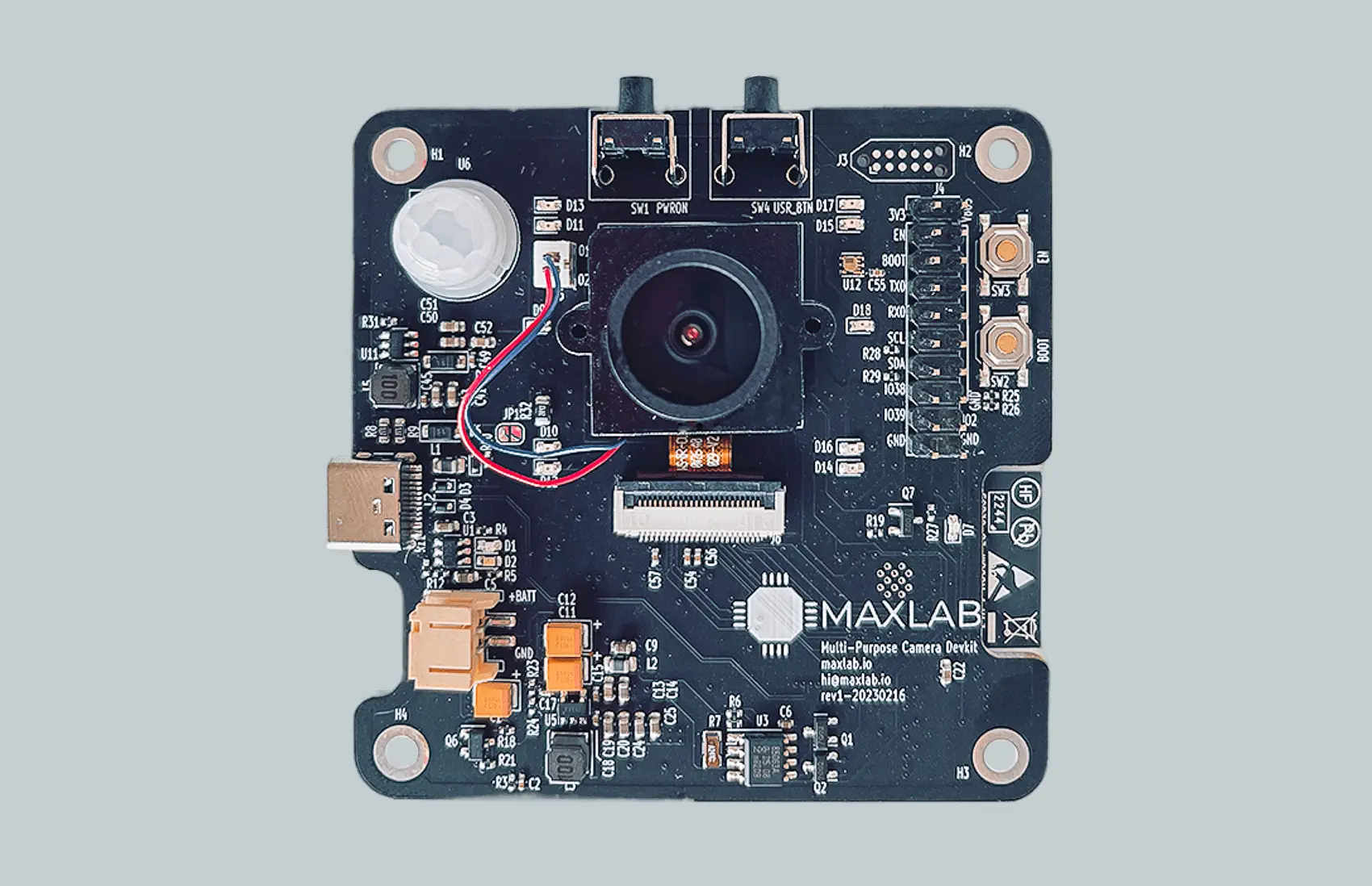
- 1–10 fpsface detection on Tokay Lite's ESP32-S3, with the included model or your own
- 4 vs 8 MBPSRAM for frames and model weights
- 0 vs 3on-board sensors and timers: PIR motion, light, real-time clock
- 10 mIR night-vision range on Tokay Lite; the ESP32-CAM has a white flash LED
Pick one in a minute
The choice comes down to power and what else you would have to buy. The details follow, but most readers can stop here.
Pick the ESP32-CAM if…
- The camera sits on a USB or 5 V supply, not a battery.
- You want to record stills or clips to a microSD card.
- You are learning: Arduino examples, a $10 board and a spare in the drawer.
- You are happy to add a PIR board, a programmer and a case yourself.
Any AI-Thinker ESP32-CAM from a parts distributor. Add the ESP32-CAM-MB base or a UART adapter to program it.
Pick Tokay Lite if…
- The device runs on a battery or a small solar panel for months.
- It has to wake on motion or on a schedule and decide on the board.
- It has to see at night without lighting the scene in white.
- You want detection, wake rules and MQTT set up on a web page, with no code.
Tokay Lite on Mouser (TOKAY-LITE-01) or CrowdSupply. Programs over USB-C.
Battery life: milliamps against microamps
"ESP32 cam battery life" is the question that decides most projects. The ESP32 chip itself sleeps at tens of microamps, but on an ESP32-CAM the linear regulator and the camera stay powered, so the board as sold draws a few milliamps in deep sleep. A 1,200 mAh cell is flat in about a week before the camera has taken a single picture on purpose.
People fix this by cutting the regulator out and switching the camera's power with a transistor. That works, and it is also a description of what Tokay Lite does on the board: an external real-time clock holds the main regulator off until the timer or the PIR sensor fires, so standby is microamps. The solar roof camera we built on this platform runs about six months on one charge.
Our battery-life guide shows how to work out your own case from sleep current, wake time and uploads per day.
The questions people ask, answered for both boards
Short answers here. The FAQ at the end has the longer ones.
Can an ESP32-CAM detect motion?
Only in software, by comparing frames while the camera is awake and powered, which rules out battery use. There is no motion sensor on the board; people add a PIR module on a GPIO. Tokay Lite has the PIR sensor on the board and uses it to wake from standby, so detection costs nothing until something moves.
Can I use it for face recognition?
Espressif's camera example runs face detection and a small face-recognition demo on the ESP32-CAM at a few frames per second at low resolution, and it uses most of the chip. Tokay Lite ships with face detection at 1–10 fps on the ESP32-S3, whose vector instructions are built for this, and takes your own TensorFlow Lite Micro or esp-dl model. Neither board does recognition of a crowd; for that we build on Tokay Pro.
Does it have night vision?
The ESP32-CAM has a bright white LED next to the lens. It lights a scene at close range and announces the camera to everything in it. Tokay Lite has infrared LEDs that reach about 10 m, a switchable IR-cut filter so day pictures keep their colour, and a light sensor that tells the firmware which mode to use.
Does it have an SD card slot?
The ESP32-CAM does, and it is the better board for saving pictures or clips locally. Tokay Lite has no SD slot: it is designed to run a model, send the result or the picture over Wi-Fi by HTTP or MQTT, and go back to sleep. If you need local storage and battery life together, that is a custom board, and we build those.
Is the ESP32-CAM the same as an ESP32?
An ESP32 is the chip. An ESP32-CAM is a module that puts that chip on a board with a camera connector, 4 MB of PSRAM and a microSD slot. It has no USB port, so you program it through a UART adapter or the ESP32-CAM-MB base. Tokay Lite uses the newer ESP32-S3 variant and programs over its USB-C port, or not at all if the built-in detection does what you need.
Wi-Fi, Bluetooth, microphone?
Both have Wi-Fi. The ESP32-CAM has classic Bluetooth and BLE; the ESP32-S3 on Tokay Lite has BLE only, which is what phones use for setup. Neither board has a microphone. Both expose spare pins: a handful of GPIOs on the ESP32-CAM, most of them shared with the camera and SD card, and SPI plus UART headers on Tokay Lite.
Side by side
ESP32-CAM figures are for the common AI-Thinker board. Tokay Lite figures are from its specification.
| Item | ESP32-CAM | Tokay Lite |
|---|---|---|
| Processor | ESP32, two cores, 240 MHz | ESP32-S3 module, two cores, 240 MHz, vector instructions for neural networks; pre-certified FCC, ISED, CE |
| Memory | 4 MB flash, 520 kB RAM, 4 MB PSRAM | 16 MB flash, 512 kB RAM, 8 MB PSRAM |
| Camera | OV2640, 2 MP | OV2640, 2 MP, up to 15 fps; other DVP sensors for volume orders |
| Night vision | White flash LED | IR LEDs to about 10 m, switchable IR-cut filter |
| Sensors and timer | None on the board | PIR motion, ambient light, external real-time clock that cuts power in standby |
| Standby current | A few milliamps as sold; microamps only with board modifications | Microamps, regulator switched off by the real-time clock |
| Power input | 5 V pin; no battery connector or charger | 1-cell LiPo on 2 mm JST-PH, charger on board, USB-C (1 A supply or better) |
| Programming | UART adapter or ESP32-CAM-MB base; Arduino, ESP-IDF | USB-C; no-code web page, Arduino or ESP-IDF with the open SDK |
| AI runtime | Espressif examples; esp-dl face detection demo | TensorFlow Lite Micro, esp-dl; face detection included at 1–10 fps; Edge Impulse |
| Storage and output | microSD slot; Wi-Fi streaming example | No SD card; HTTP, MQTT, AWS IoT, ThingsBoard, Edge Impulse from the web page |
| Radios | Wi-Fi, Bluetooth Classic and BLE | Wi-Fi, Bluetooth LE |
| Enclosure and temperature | Third-party cases; commercial-grade parts | Enclosure available; −40 °C to +50 °C |
| Design files | Schematic published by AI-Thinker | Open hardware, CERN-OHL-P-2.0; firmware and SDK Apache 2.0 |
| Price | About $10 | $102 on Mouser (TOKAY-LITE-01) and CrowdSupply |
When neither board is the answer
A prototype on either board tells you whether the idea works. A product needs a different sensor, a particular enclosure, a radio you do not have, or the SD card and the battery life together. That is the electronics and firmware work we do: the solar roof camera on our work page started as the Tokay Lite platform and shipped 9,500 units.
Start with a board, prove the model and the wake rules, then send us the numbers. We quote the custom design, write the firmware and run the FCC Part 15B testing the end product needs on top of the module's radio approvals.
- Prove it
- One Tokay Lite from Mouser, your model, your wake rules
- Then
- Custom sensor, enclosure, radios, firmware, certification
- Shipped on this platform
- 9,500 roof cameras, about six months per charge
- Typical timeline
- 3 months to a year, see the cost and timeline guide
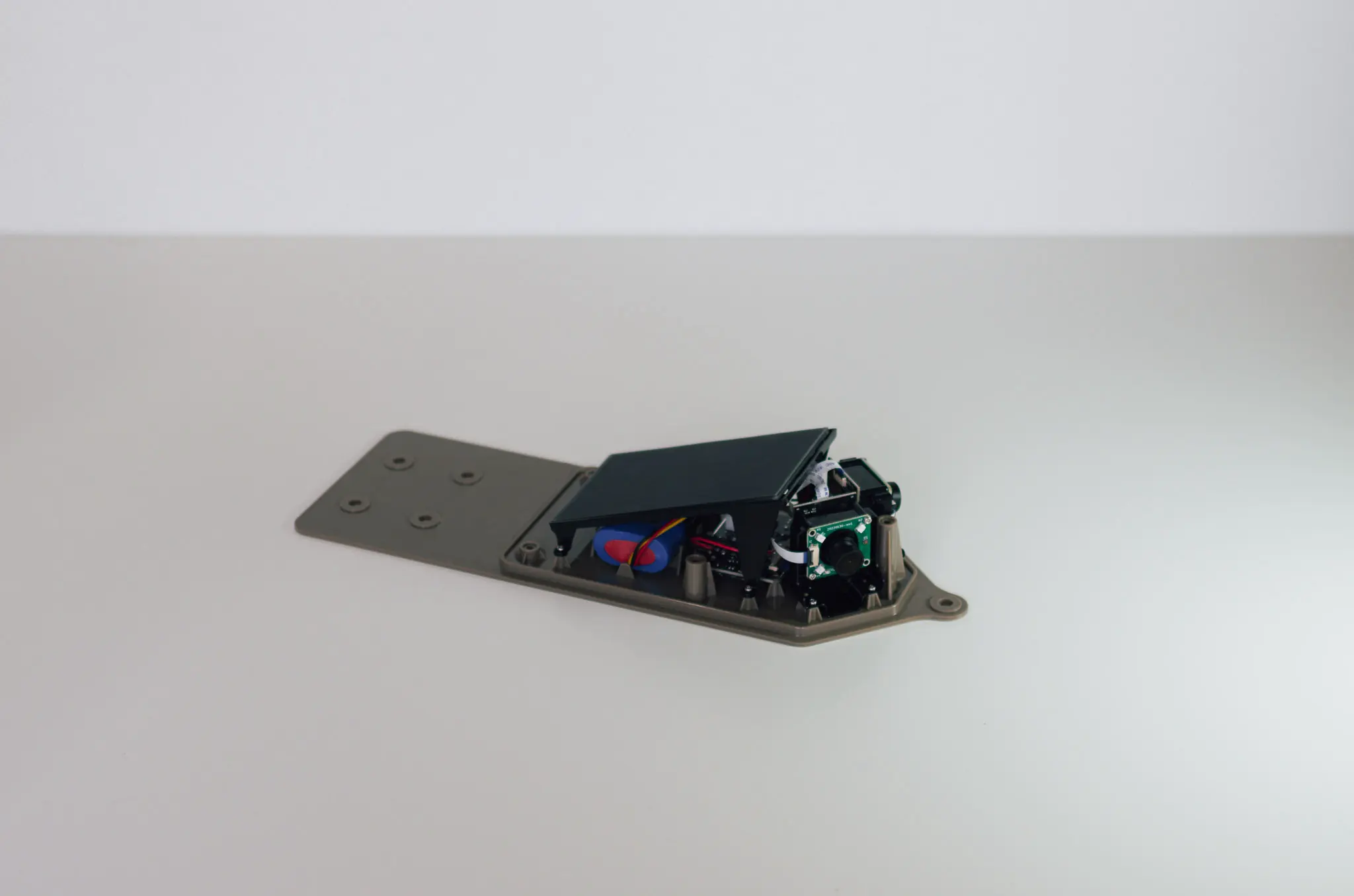
Get a Tokay Lite, or ask what your camera would take
Single boards ship from Mouser and CrowdSupply today. If you already know an off-the-shelf board will not do, send what the device has to do and we reply within 24 hours.
Or email [email protected] or book a 30-minute call.
Common questions
Are ESP32 cameras good?
For detection and for pictures you can read, yes. Both the ESP32-CAM and Tokay Lite use a 2 MP OV2640 sensor and run small neural networks on the chip, which covers wake-on-event cameras, counting and presence checks. They are not security-grade 4K cameras and they do not stream for hours on a battery. For several objects at a time or full video we build on the Linux-based Tokay Pro.
Can the ESP32-CAM detect motion?
Not with a sensor: the board has none. It can compare frames in software while it is awake and powered, which is fine on a mains supply and useless on a battery, or you can wire a PIR module to a GPIO. Tokay Lite has the PIR motion sensor on the board and uses it to wake from standby.
Can I use an ESP32-CAM for face recognition?
Espressif's camera example runs face detection and a small face-recognition demo on the ESP32-CAM at a few frames per second at low resolution. It works as a demo and uses most of the chip. Tokay Lite ships with face detection at 1–10 fps on the ESP32-S3 and accepts your own TensorFlow Lite Micro or esp-dl model.
Is the ESP32-CAM the same as an ESP32?
No. The ESP32 is the chip. The ESP32-CAM is a module that puts that chip on a small board with a camera connector, 4 MB of PSRAM, a microSD slot and a flash LED, and leaves out USB. Tokay Lite is built on the ESP32-S3, a newer variant of the same family with vector instructions for neural networks.
What is the ESP32-CAM's battery life?
Short, as sold. The board's linear regulator and the camera stay powered in deep sleep, so it draws a few milliamps and a 1,200 mAh cell lasts about a week. With the regulator bypassed and the camera's power switched, people get it down to around a milliamp, about seven weeks on the same cell. Tokay Lite switches its regulator off in standby and draws microamps; the roof camera built on it runs about six months on one charge. Our battery-life guide shows how to work out your own case.
Does the ESP32-CAM have night vision?
No. It has a bright white LED beside the lens that lights a scene at close range. Tokay Lite has infrared LEDs that reach about 10 m, a switchable IR-cut filter and a light sensor that picks the mode, so night pictures come out black and white and the camera stays dark.
Does it have an SD card slot?
The ESP32-CAM does, and it is the better board for saving pictures or clips locally. Tokay Lite does not: it runs the model and sends the result or the picture over Wi-Fi by HTTP or MQTT, then sleeps.
What is the quality of the OV2640 camera?
The OV2640 is a 2 MP sensor from 2008-era phone cameras. It gives a readable 1600 × 1200 JPEG in daylight and a usable black-and-white image under IR, and it is enough for detection models that run at 96 to 320 pixels anyway. It is not a sensor for licence plates at 30 m or for colour at night. Tokay Lite can take other DVP sensors in volume orders.
Does the ESP32-CAM have Wi-Fi and Bluetooth?
Yes, both: Wi-Fi and Bluetooth Classic plus BLE from the ESP32. Tokay Lite has Wi-Fi and Bluetooth LE from the ESP32-S3 module. Neither has a microphone.
How much is an ESP32 camera?
An ESP32-CAM is about $10, plus a UART adapter or the ESP32-CAM-MB base to program it, a PIR board, a case and a battery charger if you want any of those. Tokay Lite is $102 on Mouser and CrowdSupply with those parts on the board and USB-C.
How do I program an ESP32 camera?
The ESP32-CAM has no USB port, so you connect a UART adapter or plug it into the ESP32-CAM-MB base, hold GPIO0 low and flash it from the Arduino IDE or ESP-IDF. Tokay Lite flashes over USB-C with the same tools and the open SDK at github.com/maxlab-io/tokay-lite-sdk. You can also skip programming: detection, wake rules and the HTTP or MQTT integration are set on the camera's own web page.
Can I get a camera like this built for my product?
Yes. Tokay Lite is the development board; the same platform went into a solar roof camera that shipped 9,500 units. We change the sensor, add or remove radios, design the enclosure, write the firmware and run the FCC Part 15B testing the end product needs. Contact us with what the device has to do.