
Built to order · By quote
A machine vision camera that runs the model inside
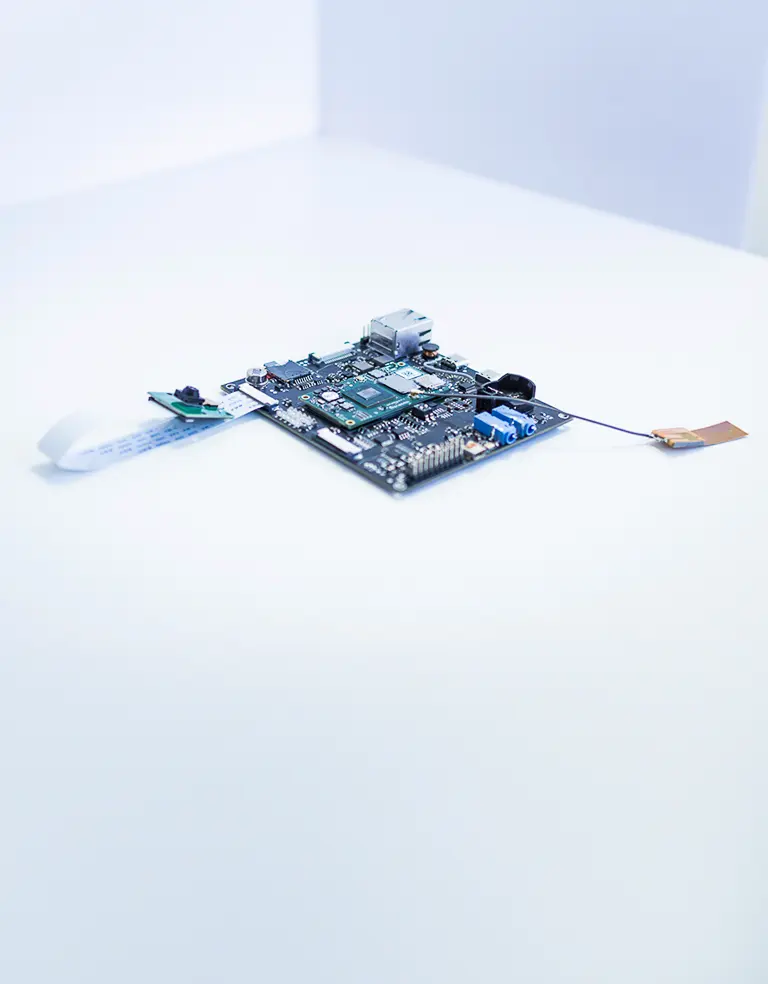
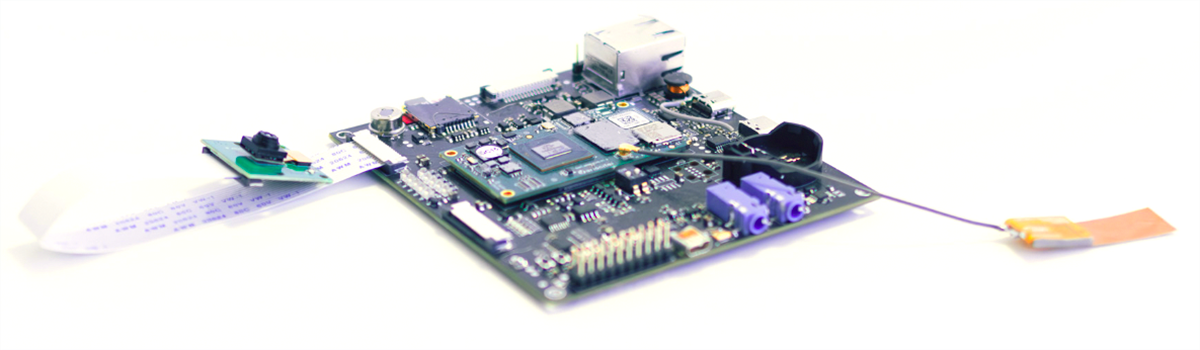
Tokay Pro is a Linux camera built on the NXP i.MX 8M Plus. It takes up to three sensors at once, detects and tracks several objects per frame on its own 2.3 TOPS accelerator, and sends out results instead of video. No PC sits at the line.
- 8 MP IMX219 sensor as standard, 30 fps raw and H.264 at 30 fps; any module with a Raspberry Pi camera connector fits.
- Three sensor ports, so visible, thermal and spectral images can be read from one device.
- Industrial-grade module rated from −40 °C to +85 °C; enclosure, power input and lenses are specified for your project.

- 2.3 TOPSof neural-network compute on the i.MX 8M Plus accelerator, so the model runs in the camera
- 8 MPIMX219 sensor as standard, 3840 × 2160 pixels per frame
- 3 sensorsread at once over MIPI-CSI: visible, thermal, spectral or 3D
- 30 fpsraw capture and H.264 encoding at full resolution
What the camera does
A machine vision camera takes a picture, runs a model on it and reports what it found: a count, a defect, a person where no person should be. Tokay Pro does all three steps on the device, which is what separates it from a sensor that streams video to a PC.
Processing without an external PC
The i.MX 8M Plus has four Cortex-A53 cores and a 2.3 TOPS neural processing unit on the same chip. A detection or tracking model runs on the NPU while the cores handle the sensor, the network and your application. The camera sends out events over Wi-Fi, writes clips to its SD card or talks to a controller over USB-C.
Because it runs Linux, the software your team already has for a PC-based vision system ports to it: OpenCV, GStreamer, TensorFlow Lite and the NXP eIQ tools. The module is supported by Variscite's Yocto and Debian board-support packages.
Several sensors in one camera
Three MIPI-CSI ports take any module with a Raspberry Pi camera connector. The standard fit is the 8 MP IMX219 for visible light; a thermal or spectral module can sit beside it, so one camera can check a pharmaceutical blister for a missing tablet and a seal for heat at the same time.
Onboard IR LEDs and the PIR motion sensor let the same unit watch a yard or a parking area at night and wake on movement, with the model deciding whether the moving thing is a person or a vehicle.
Production lines, packaging and sites
On a production line the camera counts parts, checks fill level and label position, or confirms an operator has stepped back before a machine cycles. Pointed at a machine, it records how long the tool runs and how long it waits, which is the usage figure a plant manager asks for. In packaging it reads whether a case is sealed and whether the right number of units went in.
Accuracy depends on the model and the lighting more than on the camera. We train or adapt the model for the parts you make, and we can design the mount and lighting as part of the project.
What it costs
Tokay Pro is supplied by quote, as a camera or as the base for your own product. The price depends on quantity, which sensors you need and whether we build an enclosure and firmware for you. A single camera for evaluation costs more per unit than a batch of fifty with your logo on the housing.
Send the quantity and the job and we reply with a price and lead time.
What is inside
The camera is a carrier board around a Variscite DART-MX8M-PLUS system-on-module. The module carries the processor, memory, storage and radio; the carrier adds the sensor ports, the PIR, the microphone, the GPIO expander and power.
What happens to a frame
The IMX219 delivers 8 MP frames over MIPI-CSI at 30 frames per second. The i.MX 8M Plus video unit encodes them to H.264 at the same rate, so a clip can be recorded or streamed without loading the processor cores.
In parallel, the NPU runs the detection model on each frame and tracks objects between frames. The output is an event with a timestamp and a position, a count, or a short clip around the event. That is what leaves the camera, over Wi-Fi to your system or Rainforest IoT, over USB-C to a controller, or onto the SD card.
Frame rate at full resolution is set by the sensor and encoder. Model throughput depends on the model: a small detector runs on every frame, a large one on every second or third frame.
Specification
| Item | Tokay Pro |
|---|---|
| Processor | NXP i.MX 8M Plus, 4 × Cortex-A53 at 800 MHz, 2.3 TOPS NPU |
| Module | Variscite DART-MX8M-PLUS, industrial grade −40 °C to +85 °C |
| Memory | 2 GB RAM, 4 GB eMMC, SD card slot |
| Camera interface | 3 × MIPI-CSI, Raspberry Pi camera connector |
| Standard sensor | Sony IMX219, 8 MP, 3840 × 2160 |
| Frame rate | 30 fps raw; H.264 encoding at 30 fps |
| Night vision | Yes, IR LEDs |
| Sensors | PIR motion sensor (AS312), light sensor, MEMS microphone |
| Expansion | PCAL6408A GPIO expander |
| Connectivity | Wi-Fi, Bluetooth, USB-C |
| Power | USB-C with backup battery; other inputs per project |
| Operating system | Linux (Variscite Yocto or Debian BSP) |
| Availability | By quote; enclosure and sensors specified per project |
Datasheets
How it fits with our other products
Tokay Pro is the mains-powered end of our camera range. Tokay Lite is the battery one: an ESP32-S3 board that sleeps on microamps, wakes on motion and answers a yes-or-no question. When the job needs more than one object per frame, more than one sensor, or 8 MP, it moves to Tokay Pro. Both report to Rainforest IoT or to your own system over MQTT or HTTP.
We designed the camera ourselves, so we can change it. A different lens, a PoE input, a sealed housing for a wash-down area, firmware that speaks your PLC's protocol: these are development work we have done on our own boards before. Three client devices built the same way are on the work page.
- Supplied
- By quote, as a camera or as the base for your product
- Changeable
- Sensors, lens, enclosure, power input, firmware
- Connects to
- Rainforest IoT, AWS IoT, ThingsBoard, your own system
- Questions
- [email protected], +1 587 557 5865

Tell us what the camera has to see
Send the quantity, the objects or defects to detect, the lighting and where the camera will be mounted. We reply within 24 hours with a price, a lead time and whether Tokay Pro or Tokay Lite is the better fit.
Or email [email protected]. For a battery-powered camera, see Tokay Lite.
Common questions
What is a machine vision camera?
A camera that takes an image, runs software on it and reports a result (a count, a measurement, a pass or fail) rather than showing the picture to a person. Tokay Pro does the image processing on its own processor, so it is both the camera and the computer.
Which operating system does Tokay Pro run?
Linux. Its Variscite DART-MX8M-PLUS module is supported by Variscite's Yocto and Debian board-support packages, so standard Linux tools and camera frameworks run on it.
Does it need an external PC to process images?
No. The NXP i.MX 8M Plus has a 2.3 TOPS neural processing unit and four Cortex-A53 cores, so detection and tracking run inside the camera. It sends out events, counts or short clips over Wi-Fi, USB-C or to its SD card.
Is Tokay Pro available to buy?
By quote. Tell us your quantity and which sensors you need, and we reply with price and lead time.
How much does an AI camera like this cost?
It depends on quantity, the sensors fitted and whether we build an enclosure and firmware for you, so we quote each project. A single evaluation unit costs more per camera than a batch.
Can it be used in industrial settings?
The DART-MX8M-PLUS module is available in an industrial-temperature grade (−40 °C to +85 °C). Enclosure, power input and sensors are specified per project.
Can it monitor equipment usage in a factory?
Yes. Pointed at a machine or a work cell, the camera records when the tool is running, idle or being loaded and sends the times as events. The model is trained on your equipment, and the camera keeps no video unless you want clips of exceptions.
Is it accurate enough for production or pharma inspection?
Accuracy comes from the model, the lens and the lighting as much as from the camera. The 8 MP sensor and the option of a thermal or spectral module beside it give the model more to work with, and we design the mount and lighting with the camera. We test the model on your parts before quoting an accuracy figure.
Which sensors can it take?
Any module with a Raspberry Pi camera connector, up to three at once over MIPI-CSI. The standard fit is the Sony IMX219 (8 MP). Thermal, spectral and 3D modules can be fitted alongside it.
Does it have night vision and a motion sensor?
Yes. Onboard IR LEDs light the scene for the sensor in the dark, and an AS312 passive-infrared sensor detects movement so the camera can wake or trigger on it. A light sensor and a MEMS microphone are on the board too.
Can it detect people in a parking lot or along a fence?
Yes. With the IR LEDs and the PIR sensor it watches a yard or parking area at night, and the model separates a person or vehicle from an animal or blowing debris before an alert is sent.
Can it work with Rainforest IoT?
Yes. Tokay Pro can send data directly to your own system or through Rainforest IoT, our hosted device-management platform built on ThingsBoard.
How is it different from Tokay Lite?
Tokay Lite is a battery camera on an ESP32-S3 with a 2 MP sensor that answers one question per wake-up, such as whether a person is present. Tokay Pro runs Linux on mains or USB-C power, takes 8 MP frames at 30 fps from up to three sensors and tracks several objects at once. The store page has both side by side.