Low-power design · Updated October 2026
The best low-power wireless MCUs for IoT in 2026
22 current wireless microcontrollers compared from their datasheets, with the sleep current, radio current and on-chip AI that decide how long a battery device lasts.
Quick answers
- Which MCU for a battery sensor that reports every few minutes? A Bluetooth LE or 802.15.4 part such as the Nordic nRF54L15, Silicon Labs EFR32BG22 or TI CC2340R5. More
- Which Bluetooth LE MCU has the lowest standby current? ST STM32WB55 at 0.6 µA and TI CC2340R5 under 0.71 µA, both with the clock running and RAM kept. More
- Is Wi-Fi too power-hungry for a battery device? Joining a network costs more than a thousand times the charge of a Bluetooth LE packet, so Wi-Fi suits devices that wake rarely or move a lot of data. More
- Which low-power MCU runs AI models on the chip? The Ambiq Apollo510 for always-on inference, the EFR32MG24 with its MVP accelerator when you also need a radio, and the ESP32-S3 for camera work over Wi-Fi. More
- Which parts support Matter? EFR32MG24, nRF54L15, nRF5340, STM32WBA65, ESP32-H2 and MCX W71 over Thread; SiWG917 and ESP32-C6 over Wi-Fi. More
- Parts compared22from Espressif, Nordic, Silicon Labs, TI, ST, NXP, Ambiq, Infineon and Renesas
- Lowest standby0.36 µAwith the clock running, ST STM32WL55 at 3 V
- Wi-Fi join vs BLE packet>1,000×the charge of a Bluetooth LE packet, spent on one Wi-Fi join
- Wi-Fi, idle connected65 µASilicon Labs SiWG917 staying connected to a Wi-Fi access point
Which low-power MCU is best for each kind of device
A wireless microcontroller puts the processor, memory and radio on one chip. For a battery-powered device it decides three numbers: how much current the device draws asleep, how much energy each radio message costs, and how much processing you get per milliamp when awake.
Battery sensor that reports every few minutes
A Bluetooth Low Energy or 802.15.4 part such as the Nordic nRF54L15, Silicon Labs EFR32BG22 or TI CC2340R5. They sleep at 0.7–1.5 µA with the real-time clock running and send a packet in milliseconds at 3–5 mA.
Smart-home devices and Matter
A part with both Bluetooth LE and 802.15.4 (Thread and Zigbee): Silicon Labs EFR32MG24, Nordic nRF5340 or nRF54L15, ST STM32WBA65, Espressif ESP32-H2 or NXP MCX W71. For Matter over Wi-Fi, look at the Espressif ESP32-C6 or Silicon Labs SiWG917.
On-device AI
The Ambiq Apollo510 (Arm Cortex-M55 with Helium vector instructions) for always-on inference, paired with a radio chip or as the Bluetooth version Apollo510B. If you need wireless and machine learning in one chip, the Silicon Labs EFR32MG24 and MG26 have a matrix-vector accelerator (MVP) on selected part numbers. For camera work with Wi-Fi, the ESP32-S3's vector instructions and external PSRAM are hard to beat on price; we built Tokay Lite on it.
Industrial IoT
It depends on range. For kilometres without a mobile contract, ST STM32WL (LoRa) or TI CC1352P (sub-GHz plus 2.4 GHz, Wi-SUN). For no gateway at all, Nordic nRF9151 (LTE-M and NB-IoT). For machines with a CAN bus, NXP KW45 or MCX W71, which add CAN FD to Bluetooth LE.
Wearables
Ambiq Apollo4 Blue Plus when the device has a display (2.75 MB RAM, a GPU and a MIPI DSI interface); Nordic nRF5340 or nRF54L15 and Renesas DA14592 when it doesn't.
Wi-Fi on a battery
Silicon Labs SiWG917, which stays associated to the access point at 65 µA (DTIM 10), or Espressif ESP32-C6. Both support Wi-Fi 6 Target Wake Time.
Arduino projects
The Espressif ESP32-C3, C6 and S3, all supported by Arduino-ESP32, or the Nordic nRF52840 used on the Arduino Nano 33 BLE.
Battery-powered cameras
An ESP32-S3 with external PSRAM, kept powered off by a real-time clock or a motion sensor until there is something to see. That is how Tokay Lite works; ESP32-CAM vs Tokay Lite compares it with the common ESP32-CAM board.
How to choose a low-power wireless MCU
Choose the radio first. The radio decides most of the energy budget and whether you need a gateway. Then pick the chip.
Compare sleep current under the same conditions. Datasheets quote the deepest sleep with different amounts of RAM kept alive, different clocks and different supply voltages. The table below states each condition; a figure without RAM retention or a running real-time clock is not the one your device will see.
Look at the energy per message, not the peak current. A Bluetooth LE packet takes about a millisecond at 3–6 mA. Joining a Wi-Fi network takes one to three seconds at around 100 mA. That is more than a thousand times the charge, and it outweighs any difference in sleep current. Our post on estimating battery life shows the arithmetic.
Weigh the software and the certified modules. A mature SDK, a certified Bluetooth or Matter stack and a pre-certified radio module save months. Using a pre-certified module lets your product rely on the module's FCC and CE radio approvals, though the finished product still needs its own emissions testing.
Which radio for which job
Range depends on transmit power, antenna and walls more than on the protocol; the Bluetooth SIG itself quotes anything from under a metre to over a kilometre.
| Radio | Band | Data rate | Network | Typical battery life | Good for |
|---|---|---|---|---|---|
| Bluetooth LE | 2.4 GHz | 125 kbps – 2 Mbps | Point to point, phone; mesh possible | Years on a coin cell at low duty cycle | Wearables, phone-configured sensors, beacons |
| Zigbee | 2.4 GHz in practice (spec also allows 868/915 MHz) | 250 kbps | Mesh, needs a hub | One to two years on a coin cell | Smart-home sensors and switches |
| Thread / Matter | 2.4 GHz (802.15.4) | 250 kbps | IPv6 mesh, needs a border router | Similar to Zigbee | Matter smart-home devices |
| Wi-Fi 4 / Wi-Fi 6 | 2.4 GHz (some 5 GHz) | Mbps | Existing access point | Months on AA cells with infrequent uploads | Cameras, devices that move a lot of data |
| LoRa | Sub-GHz (868 / 915 MHz) | About 0.3–27 kbps | Star, needs a gateway | Years, sending a few bytes | Farms, utilities, long range |
| LTE-M / NB-IoT | Licensed cellular | Tens of kbps to about 1 Mbps | Mobile operator, no gateway | Months to years with power-saving modes | Trackers, remote assets |
Which wireless MCU draws the least current
Sleep current first, then the current while the radio is on. Both charts use the figures from the comparison table below, with the conditions each manufacturer states.
Comparison of 22 current parts
Figures are copied from each manufacturer's datasheet or product page in October 2026. Espressif quotes peak radio currents at 3.3 V; most others quote averages, sometimes without stating the supply voltage, so compare within a vendor before comparing across vendors. Sleep figures assume the RAM and clock stated in brackets.
| Part | Core | Radios | Deepest sleep with RAM or RTC kept | RX / TX at 0 dBm | Flash / RAM | ML hardware |
|---|---|---|---|---|---|---|
| Espressif ESP32-S3 | 2× Xtensa LX7, 240 MHz | Wi-Fi 4, BLE 5 | 7 µA (deep sleep, RTC memory on) | 93 / 176 mA peak (BLE) | external / 512 KB | Vector instructions |
| Espressif ESP32-C3 | RISC-V, 160 MHz | Wi-Fi 4, BLE 5 | 5 µA (deep sleep, RTC timer + memory) | 84 mA RX (Wi-Fi) | external / 400 KB | — |
| Espressif ESP32-C6 | RISC-V, 160 MHz + LP core | Wi-Fi 6, BLE 5.3, Thread, Zigbee | 7 µA (deep sleep, RTC timer + LP memory) | 71 / 130 mA peak (BLE) | external / 512 KB | — |
| Espressif ESP32-H2 | RISC-V, 96 MHz | BLE 5.3, Thread, Zigbee | 7 µA (deep sleep, RTC timer + LP memory) | 24 / 36 mA peak (BLE) | external / 320 KB | — |
| Nordic nRF52840 | Cortex-M4F, 64 MHz | BLE 5.4, Thread, Zigbee | 3.16 µA (System ON, 256 KB RAM, RTC) | 4.6 / 4.8 mA | 1 MB / 256 KB | — |
| Nordic nRF5340 | 2× Cortex-M33, 128 + 64 MHz | BLE 5.4 (LE Audio), Thread, Zigbee | 1.5 µA (System ON, RTC, 3 V, DC-DC) | 3.7 / 4.1 mA | 1 MB / 512 KB | — |
| Nordic nRF54L15 | Cortex-M33 + RISC-V, 128 MHz | BLE 6.0 Channel Sounding, Thread, Zigbee | 1.5 µA (System ON, 64 KB RAM, GRTC) | 3.4 / 4.8 mA | 1.5 MB / 256 KB | — |
| Nordic nRF9151 | Cortex-M33, 64 MHz | LTE-M, NB-IoT, DECT NR+, GNSS | not published on product page | — | 1 MB / 256 KB | — |
| Silicon Labs EFR32MG24 | Cortex-M33, 78 MHz | BLE 6.0, Thread, Zigbee, Matter | 1.3 µA (EM2, 16 KB RAM, RTC) | 4.4 / 5 mA | 1.5 MB / 256 KB | MVP (select parts) |
| Silicon Labs EFR32BG22 | Cortex-M33, 76.8 MHz | BLE 5.4 | 1.4 µA (EM2, 32 KB RAM, RTC) | 3.6 / 4.1 mA | 512 KB / 32 KB | — |
| Silicon Labs SiWG917 | Cortex-M4F, 180 MHz | Wi-Fi 6, BLE 5.4, Matter | ~2.5 µA deep sleep; 65 µA associated (DTIM 10) | — | up to 8 MB / 672 KB | — |
| TI CC2340R5 | Cortex-M0+, 48 MHz | BLE 5.4, Thread, Zigbee | <0.71 µA (standby, RTC, full RAM) | 5.3 / 5.1 mA | 512 KB / 64 KB | — |
| TI CC1352P | Cortex-M4F, 48 MHz | Sub-GHz + 2.4 GHz, BLE, Thread, Zigbee, Wi-SUN | 0.85 µA (standby, RTC, 80 KB RAM) | 5.8 mA RX (868 MHz) | 352 KB / 88 KB | — |
| ST STM32WBA65 | Cortex-M33, 100 MHz | BLE 6.0 (LE Audio), Thread, Zigbee, Matter | 1.33 µA (standby with RTC) | 4.26 / 5.94 mA | 2 MB / 512 KB | — |
| ST STM32WB55 | Cortex-M4 + M0+, 64 MHz | BLE 5.4, Thread, Zigbee, Matter | 0.6 µA (standby, RTC, 32 KB RAM) | 4.5 / 5.2 mA | 1 MB / 256 KB | — |
| ST STM32WL55 | Cortex-M4 + M0+, 48 MHz | LoRa, (G)FSK, 150–960 MHz | 0.36 µA (standby with RTC, 3 V) | 4.82 mA RX / 15 mA TX at 10 dBm | 256 KB / 64 KB | — |
| NXP MCX W71 | Cortex-M33, 96 MHz | BLE, Thread, Zigbee, Matter; CAN FD | <3 µA (power-down, RTC, 32 KB RAM) | 4.7 / 4.6 mA | 1 MB / 128 KB | — |
| Ambiq Apollo4 Blue Plus | Cortex-M4F, 192 MHz | BLE 5.4 | 8.2 µA (deep sleep 2, 8 KB retained, 3.3 V) | 5.9 / 5.2 mA | 2 MB / 2.75 MB | GPU (graphics) |
| Ambiq Apollo510 | Cortex-M55, 250 MHz | none (BLE on Apollo510B) | 23.8 µW (deep sleep 2, 160 KB retained, 1.8 V) | — | 4 MB / 3.75 MB | Helium vector extension |
| Infineon CYW20829 | Cortex-M33, 96 MHz | BLE 5.4 | 4.5 µA (deep sleep, 64 KB RAM) | 5.6 / 5.2 mA | external / 256 KB | — |
| Renesas DA14592 | Cortex-M33F + M0+, 64 MHz | BLE 5.2 | 2.6 µA (extended sleep, 32 KB RAM, RTC) | 1.2 / 2.3 mA (radio only) | 256 KB / 96 KB | — |
| NXP RW612 | Cortex-M33, 260 MHz | Wi-Fi 6 dual-band, BLE 5.4, Thread | not published on product page | — | external / 1.2 MB | — |
What each chip maker does best
The SDK and the community around a chip shorten development more than any datasheet figure, so the vendor matters as much as the part.
Espressif: the most capable Wi-Fi parts per dollar
Espressif's chips are the default for anything that moves data over Wi-Fi: cameras, displays, devices that stream to the cloud. The ESP-IDF framework, Arduino-ESP32 and the size of the community shorten development more than any datasheet figure. The ESP32-S3 adds vector instructions for neural networks and supports octal PSRAM for camera frames. The ESP32-C6 brings Wi-Fi 6 with Target Wake Time plus Thread and Zigbee, and the ESP32-H2 drops Wi-Fi entirely for a Thread and Zigbee node.
The trade-off is energy per message. Deep sleep at 5–7 µA is fine, but joining Wi-Fi costs more than a thousand times the charge of a Bluetooth LE packet. On battery, an Espressif design needs a strategy for waking rarely: a real-time clock, a motion sensor or a radio that stays off until it is needed. That is how Tokay Lite works: its external clock and PIR sensor keep the ESP32-S3 powered off until there is something to see.
Nordic: the Bluetooth LE reference
Nordic's nRF52840 is still the most widely supported Bluetooth LE chip, and the nRF5340 adds a second core for the radio stack and LE Audio. The new nRF54L15 cuts radio current to 3.4 mA receive and adds Bluetooth 6.0 Channel Sounding for distance measurement. The nRF Connect SDK, based on Zephyr, takes longer to learn than Nordic's older SDK but supports Bluetooth, Thread, Zigbee and Matter from one code base. For cellular, the nRF9151 combines LTE-M, NB-IoT and GNSS in one package.
Silicon Labs: smart home and Matter
Silicon Labs' EFR32 Series 2 parts are the common choice for Zigbee, Thread and Matter devices, with certified stacks and well-documented low-power modes. The EFR32MG24 sleeps at 1.3 µA with RAM and clock running and, on selected part numbers, includes the MVP accelerator for small machine-learning models. The EFR32BG22 is a cheap, low-power Bluetooth LE part for coin-cell sensors. The SiWG917 is one of the few Wi-Fi chips designed for batteries: it stays connected to the access point at 65 µA.
Texas Instruments: lowest standby and sub-GHz
The TI CC2340R5 stands by at under 0.71 µA with the clock running and all its RAM kept, one of the lowest figures among the Bluetooth LE parts here. The CC1352P and CC1354P10 combine a sub-GHz radio with 2.4 GHz, so one device can talk Wi-SUN or a long-range proprietary protocol to the field and Bluetooth LE to a phone. TI's newest Bluetooth part, the CC2745, adds a vector and matrix unit for machine learning; we found it only in automotive-qualified versions.
ST: one toolchain from sensor to LoRa
ST's wireless parts share the STM32 tools and peripherals, which helps teams that already use STM32. The STM32WBA65 is the current Bluetooth LE and 802.15.4 line, with 2 MB of flash and PSA Level 3 security certification. The older STM32WB55 stands by at 0.6 µA with the clock and 32 KB of RAM kept, lower than the WBA65. The STM32WL55 goes down to 0.36 µA and integrates a LoRa radio for sub-GHz links measured in kilometres.
NXP, Ambiq, Infineon and Renesas
NXP MCX W71 and KW45 combine Bluetooth LE with CAN FD; the KW45 is AEC-Q100 qualified for vehicles. The RW612 is a Wi-Fi 6, Bluetooth and Thread part that can act as a Thread border router.
Ambiq builds its Apollo chips on sub-threshold circuits. The Apollo4 Blue Plus suits smartwatches, with enough RAM for a display frame buffer. The Apollo510 uses a Cortex-M55 with Helium and runs neural networks without a separate NPU; it has no radio of its own.
Infineon CYW20829 is a Bluetooth LE 5.4 part with a long supply commitment (available until at least 2039). Renesas DA14592 quotes 1.2 mA receive and 2.3 mA transmit for the radio alone (other vendors mostly quote whole-chip current), and a hibernation mode under 100 nA.
How we pick an MCU for a product
We start from the reporting interval, the battery and the radio the customer's system already uses, build a power model, and test the two or three best candidates on a development board with a power analyser before laying out the PCB.
Requirements
The reporting interval, the battery and the radio the customer's system already uses.
Power model
Sleep current, energy per message and wake time turned into a battery-life estimate.
Bench test
The two or three best candidates on a development board with a power analyser.
PCB layout
Only then do we lay out the board around the chosen part.
Licensing IP rather than buying chips? Companies designing their own chip for a fitness tracker or smartwatch usually license an Arm Cortex-M core from Arm and Bluetooth LE radio IP from vendors such as Ceva or Synopsys. Most product teams are better served by one of the chips above: the radio is already certified and the low-power modes are proven. Terms such as deep sleep, NPU and Zigbee are explained in our glossary.
Where this applies at Maxlab
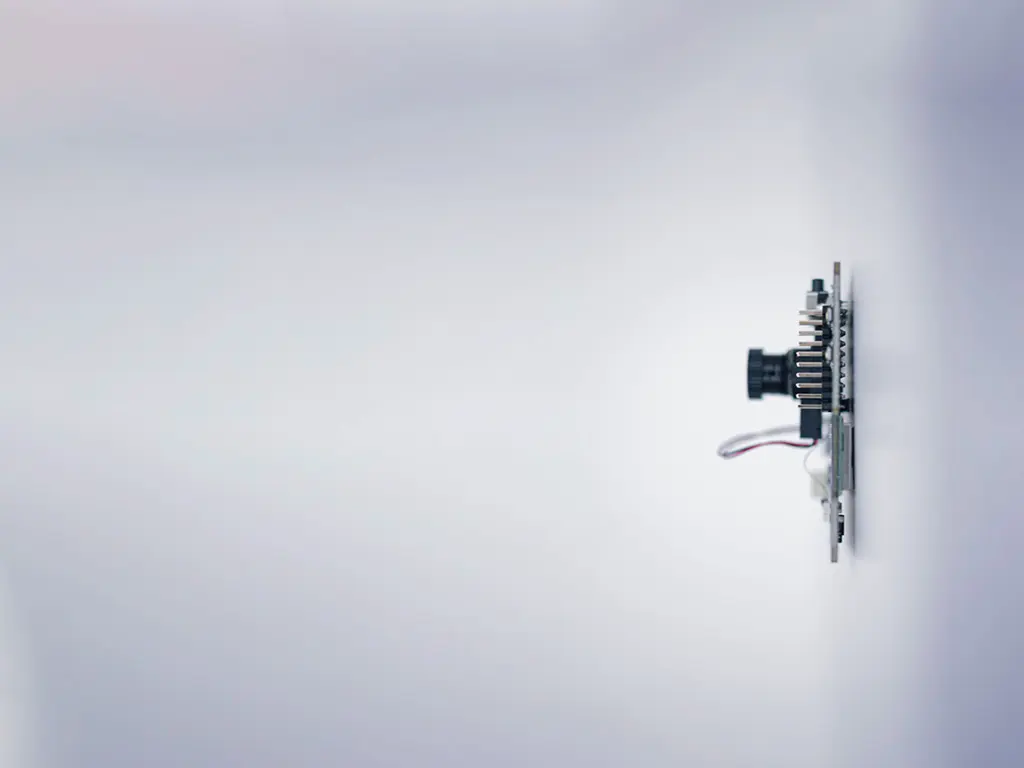
Our own camera, Tokay Lite, is an ESP32-S3 design that follows the advice above for Wi-Fi on a battery. An external real-time clock and a PIR motion sensor keep the chip powered off until there is something to see, so it draws microamps between events. The hardware and SDK are open source on GitHub, and the board is sold on Mouser.
The solar roof camera on our work page is built on the same platform and runs about six months per charge; 9,500 of them shipped. If you are choosing an MCU for your own device, our hardware development services cover that choice, the board and the firmware.
- Tokay Lite MCU
- ESP32-S3 with 8 MB PSRAM
- Wake sources
- External RTC and PIR sensor
- Roof camera battery life
- About six months per charge
- Roof cameras shipped
- 9,500
Choosing an MCU for a battery-powered device
Send us the reporting interval, the battery and the radio your system uses, and we will tell you which two or three parts we would test first. We reply within 24 hours.
Or email [email protected] or book a 30-minute call.
Common questions
What are the best ultra-low-power AI MCUs?
For always-on inference, the Ambiq Apollo510 (Cortex-M55 with Helium vector instructions, no radio; Bluetooth on the Apollo510B). For wireless and machine learning in one chip, the Silicon Labs EFR32MG24 or MG26 with the MVP accelerator on selected part numbers. For camera work over Wi-Fi, the Espressif ESP32-S3 with vector instructions and external PSRAM, which we use in Tokay Lite.
Which wireless + MCU combination is best for industrial IoT devices?
It depends on range and infrastructure. ST STM32WL (LoRa) or TI CC1352P (sub-GHz plus 2.4 GHz, Wi-SUN) for kilometre links without a mobile contract; Nordic nRF9151 (LTE-M, NB-IoT) when there is no gateway; NXP KW45 or MCX W71 when the device also sits on a CAN bus.
Which MCU with integrated wireless is best for smart-home devices?
A part with Bluetooth LE and 802.15.4 for Thread, Zigbee and Matter: Silicon Labs EFR32MG24, Nordic nRF5340 or nRF54L15, ST STM32WBA65, Espressif ESP32-H2 or NXP MCX W71. For Matter over Wi-Fi, Espressif ESP32-C6 or Silicon Labs SiWG917.
What is the best low-power Arm Cortex-M MCU for IoT devices?
Among Cortex-M33 wireless parts, the Nordic nRF54L15 (1.5 µA asleep with 64 KB RAM and clock, 3.4 mA receive), Silicon Labs EFR32MG24 (1.3 µA in EM2) and ST STM32WBA65 (1.33 µA standby with RTC) lead. TI's Cortex-M0+ CC2340R5 stands by under 0.71 µA. Choose by radio and SDK first; the sleep figures are close.
Who makes the best Bluetooth Low Energy MCU?
Nordic (nRF52840, nRF5340, nRF54L15) has the widest support. Silicon Labs (EFR32BG22), TI (CC2340R5), ST (STM32WB55, STM32WBA65), Renesas (DA14592) and Infineon (CYW20829) are strong alternatives, with lower standby current or cost in some cases.
Which Bluetooth LE MCU has the lowest power consumption?
In standby with the clock running and RAM kept: ST STM32WB55 at 0.6 µA and TI CC2340R5 under 0.71 µA. For radio current, Renesas DA14592 quotes 1.2 mA receive and 2.3 mA transmit for the radio alone, and Nordic nRF54L15 3.4 / 4.8 mA. Vendors measure differently, so test your shortlist on a development board.
What is a low-power BLE or Wi-Fi MCU?
A microcontroller with the radio on the same chip and sleep modes that draw a few microamps or less while keeping a clock and some RAM alive. BLE parts send a packet in about a millisecond at 3–6 mA; Wi-Fi parts need far more energy per connection, so they suit devices that wake rarely or move a lot of data.
What is the best low-power MCU for Arduino?
The Espressif ESP32-C3, ESP32-C6 and ESP32-S3, all supported by Arduino-ESP32, or the Nordic nRF52840 on the Arduino Nano 33 BLE.
Which wireless MCUs with Matter support are the most power-efficient?
For Matter over Thread: Silicon Labs EFR32MG24 (1.3 µA in EM2), ST STM32WBA65, Nordic nRF54L15 and nRF5340, and NXP MCX W71. For Matter over Wi-Fi: Silicon Labs SiWG917, which stays associated to the access point at 65 µA (DTIM 10), and Espressif ESP32-C6 with Wi-Fi 6 Target Wake Time.
Which companies provide ultra-low-power microcontroller IP for fitness trackers and smartwatches?
Chip designers usually license Cortex-M cores from Arm and Bluetooth LE radio IP from Ceva or Synopsys. If you are buying chips instead, Ambiq (Apollo4 Blue Plus, Apollo510), Nordic (nRF5340, nRF54L15) and Renesas (DA14592) are the common choices for wearables.